


Punakaiki Fund recently doubled-down on Couchdrop, increasing our stake to 29.1% of the quiet New Zealand company running secure file infrastructure for some of the world’s most regulated businesses. Here’s why.
Every regulated industry has the same unglamorous problem. A hospital needs to pull patient records from clinics. A bank needs to receive overnight files from brokers. A broadcaster needs to move terabytes of footage between studios. All of it has to happen securely, automatically, and with an audit trail the compliance team will sign off on.
The protocol they all reach for is forty years old. It’s called SFTP, and traditionally it lived on a server somebody had to babysit. That meant setup measured in weeks, patching by hand, and a fresh headache every time an auditor came knocking.
What does Couchdrop do?
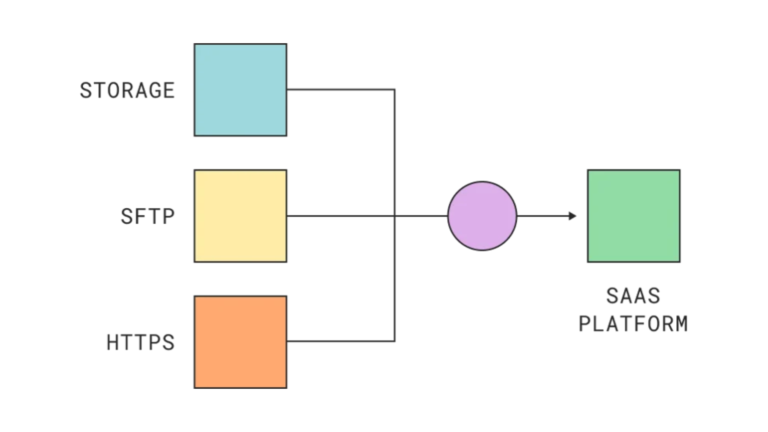
Couchdrop replaced that server. It’s a cloud-first secure file transfer and automation platform that plugs into the storage businesses already use, including SharePoint, Box, Dropbox, Amazon S3 and Google Drive. It turns SFTP plumbing into something an IT team sets up in minutes rather than weeks. Alongside it sits Movebot, a data migration platform built by the same team. Movebot lets enterprises and managed service providers move terabytes, sometimes petabytes, of files and mailboxes between cloud platforms without writing custom scripts.
The two products feed each other. Movebot is often the first point of contact, when a company is doing a major cloud migration, an M&A integration, or a Workspace-to-365 cutover. Once the data lands in its new home, Couchdrop keeps it moving securely, on a schedule, with logs auditors actually accept.
Who uses Couchdrop, and how?
The clearest way to understand Couchdrop is through the work it does every day.
- A US healthcare provider needed a HIPAA-compliant way for clinics and patients to upload sensitive documents straight into its SharePoint, without anyone emailing protected health information around. Couchdrop gave them branded, encrypted upload portals and automated feeds, so the whole intake workflow runs without an engineer on call.
- A capital markets infrastructure firm serving banks and exchanges needed cloud-native SFTP that didn’t require a dedicated virtual machine for every client. Couchdrop replaced the legacy stack with a fully-managed service that deploys in minutes, carrying the same security controls their customers’ regulators expect.
- A leading global media company first engaged Movebot in 2022 expecting to migrate around 800TB of distributed data. Movebot’s visibility tools scoped the real job down to roughly 200TB, which cut both cost and complexity, and the engagement then became an annual subscription. Multiple teams across the company now run migrations independently.
The pattern repeats. A workflow that used to live in someone’s head, or in a brittle script, becomes a button. Files move automatically, audits pass without manual reconstruction, and the engineers who used to babysit the process get to do something more useful.
Why do Couchdrop’s customers stay?
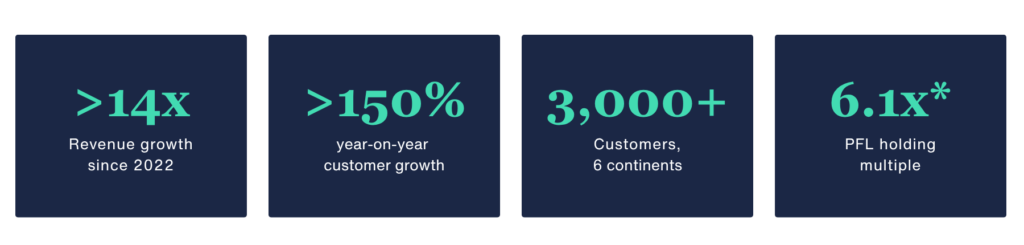
Couchdrop and Movebot are now embedded in the day-to-day operations of blue-chip enterprises across finance, healthcare, life sciences, legal and media. The company says little in public about who runs on its platform, because regulated customers prefer it that way. The scale is easier to share: more than 3,000 customers across six continents, processing over 29 million files and moving more than 500TB every month.
The more important number is what existing customers do over time. Couchdrop’s net revenue retention reached 159% among its core customers in the final quarter of FY25. In plain terms, the average customer spends materially more this year than last, before a single new customer is counted. Two things drive that. Customers add use cases as they go: a portal here, an automation there, a new partner feed. And as their data volumes grow, so do their plans.
The business has grown its revenue more than 14-fold since 2022, and it has stayed profitable and capital-efficient the whole way. That’s a team of less than 30 running infrastructure for some of the most demanding businesses in the world.
Lawson has done this before. He built and sold Linewize, a SaaS company that scaled globally. The same instinct shows in Couchdrop: take a dull, recurring problem that every regulated business has, and solve it better than the incumbents.
Does AI help or threaten Couchdrop?
A fair question about any software business this year is whether AI threatens it or helps it. For Couchdrop, the answer leans clearly toward help.
AI models run on data movement, and they need more of it as adoption deepens. A retrieval-augmented system needs structured access to enterprise documents. A training pipeline ingests from many sources. An agentic workflow reads and writes across systems all day. None of that works without the plumbing Couchdrop already provides. And when AI is in the loop, the regulated industries it serves face stricter security and audit requirements, not looser ones.
Couchdrop’s 2026 roadmap reflects this. Data-loss prevention and automated file classification shipped in the first quarter, giving customers the controls to route sensitive data into AI systems safely. Movebot’s AI-driven migration planner applies the same technology to data movement itself. The platform already connects to the data and storage layers that modern AI workloads run on. That puts Couchdrop in a part of the stack that grows as AI adoption grows.
The market is moving the same way. Managed file transfer is on track to reach roughly US$4 billion globally by 2030, and data migration is on a steeper path to around US$11 billion. Both are growing because enterprises are abandoning the legacy SFTP and migration tools Couchdrop was built to replace.
“The best software helps good people perform better, and lets great, creative people work at an outstanding level.”
Michael Lawson, founder and CEO of Couchdrop

What’s next for Couchdrop?
For the first time, Couchdrop is investing seriously in US sales and go-to-market capacity. The product already generates more inbound demand than the team can absorb, with hundreds of trial registrations a month across the two products, and three-quarters of revenue already comes from North America. New hires are there to convert that demand into a sales-assisted enterprise motion alongside the existing product-led one, and to build a deeper partner channel into the 40,000-strong North American MSP market.
The product roadmap backs the sales build. A B2B marketplace will let customers find and connect to verified trading partners inside the platform. A self-hosted data layer will serve regulated buyers who need on-premise or private-cloud deployment for sovereignty reasons. There is also a useful partnership in place: Couchdrop became a Dropbox Platform Partner in late 2022, and Movebot was later named a preferred Dropbox migration solution. That keeps both products in front of enterprise customers modernising their stack.
Punakaiki Fund’s investment in Couchdrop
Punakaiki Fund first invested in Couchdrop in March 2022. We led that round and have backed the company at every step since.
Our thesis has been the same from day one. A proven founder solving a business-critical, recurring problem for regulated industries, with strong unit economics and the capital efficiency that compounds when growth stays high. Couchdrop has reached this point on very little outside capital, and a company like this rewards patience. It has not been pushed toward an exit on someone else’s timeline. Michael remains majority shareholder and believes Couchdrop is still in the early stages of its growth opportunity, with significant potential to increase revenue and enterprise value over the coming years, and our evergreen structure is made for that.
Couchdrop is the sort of company New Zealand should produce more of. A highly productive, capital-efficient team running critical infrastructure for the world, from here. We’re proud to have backed it early, and we expect there is a lot more to come.
Couchdrop is privately held, and Punakaiki Fund is the only way to own a stake at this stage. If you are a wholesale investor and want exposure, talk to us →